Effective space management is essential to supporting the university's academic, research, and administrative mission. As our programs grow and the way we work evolves, we are committed to using every square foot as efficiently and intentionally as possible. This includes exploring shared desk environments that match contemporary hybrid work patterns, aligning our spaces with benchmark standards from peer institutions, and proactively reorganizing or relocating units to ensure each area is used for its highest and best purpose.
Space optimization allows us to expand capacity, improve collaboration, and enhance the experience for students, faculty, and staff - often without the need for new construction. The following examples illustrate how thoughtful analysis and strategic planning can unlock opportunities within the existing campus footprint while supporting long-term institutional goals.
Projects
Budget & Finance Office Consolidation
The COB Shared Workspace Initiative is a campus-wide effort designed to bring teams together, boost productivity, and support a modern hybrid work culture. We’ve optimized COB to reduce underutilized space by nearly 25%, consolidate B&F operations onto Level 2, and maximize office utilization without costly renovations. Thoughtful scheduling and flexible, people-centered environments ensure teams collaborate efficiently while maintaining continuity across departments. Delivered on time and under budget, this project reflects our commitment to an engaged, efficient, and future-ready workplace.
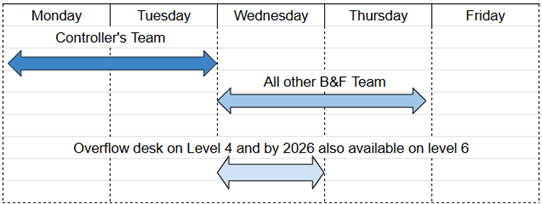
Outcome: With the COB Shared Workspace initiative successfully implemented, we’ve set a new standard for collaboration, efficiency, and adaptability. Budget and Finance released 1,227 SF on Level 4, making room for formal office space for Rice Global, 8 hoteling desks (with more planned), a focus room, a huddle room, and consolidated seating for Transportation staff. Updated COB guidelines ensure future occupants can use spaces efficiently and continue to strengthen a flexible, hybrid-friendly workplace. This initiative not only enhances productivity today but also builds a resilient, future-ready environment for tomorrow’s teams.
Project Status: Complete
Mudd Building Serving Several Strategic Initiatives
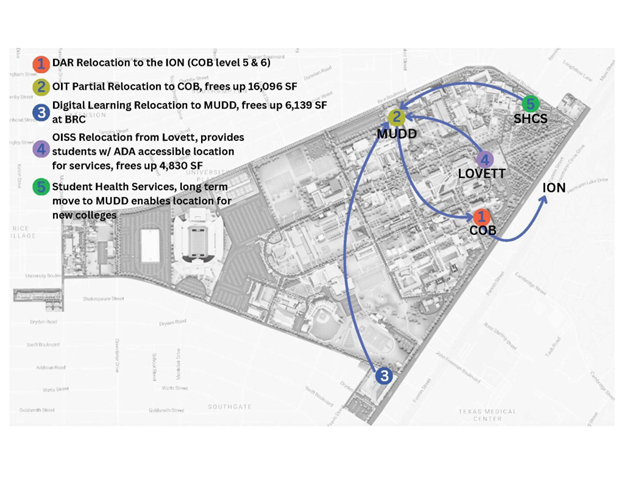
The Mudd Building Space Study brings together months of analysis and campus collaboration to clarify a clear path forward for this critical University asset. By evaluating the relocation of OIT from Mudd to the COB, the study confirms a strategic opportunity to unlock Mudd for higher-value institutional needs. The findings highlight how Mudd can now transition into a purpose-driven hub—anchoring Digital Learning and freeing 6,139 SF in the BRC, providing an ADA-accessible home for OISS, supporting Residential College growth through swing space for Student Health Services, and offering flexible classroom environments that adapt to evolving academic priorities. Together, these outcomes position Mudd to serve the University more effectively and sustainably in the years ahead.
Outcome: With the Mudd Building Space Study complete, the relocation plan is now in motion. Communications and planning with OIT staff will roll out over the coming months, with COB tours scheduled for January. These steps set the stage for a smooth transition, unlocking Mudd as a flexible, purpose-driven hub that supports the University’s strategic and academic priorities.
Project Status: Design